Why Your SEO Traffic Drops Even When Google Impressions Increase
Google Search Console shows rising impressions, but your organic clicks are falling. At first, this looks confusing. In reality, higher impressions simply mean Google is showing your pages for more searches. It does not mean users are clicking them, that you are ranking high enough, or that the additional queries are relevant to your business.
An SEO Traffic Drop alongside growing impressions usually points to problems such as falling CTR, weaker average positions, keyword cannibalization, search-intent mismatch, poor titles, irrelevant query expansion or stronger competition.
Understanding which factor is responsible is the first step toward fixing the problem. A structured SEO strategy and optimisation process helps identify whether the problem is visibility, relevance, CTR or page overlap.
What Do Higher Impressions but Lower Clicks Actually Mean?
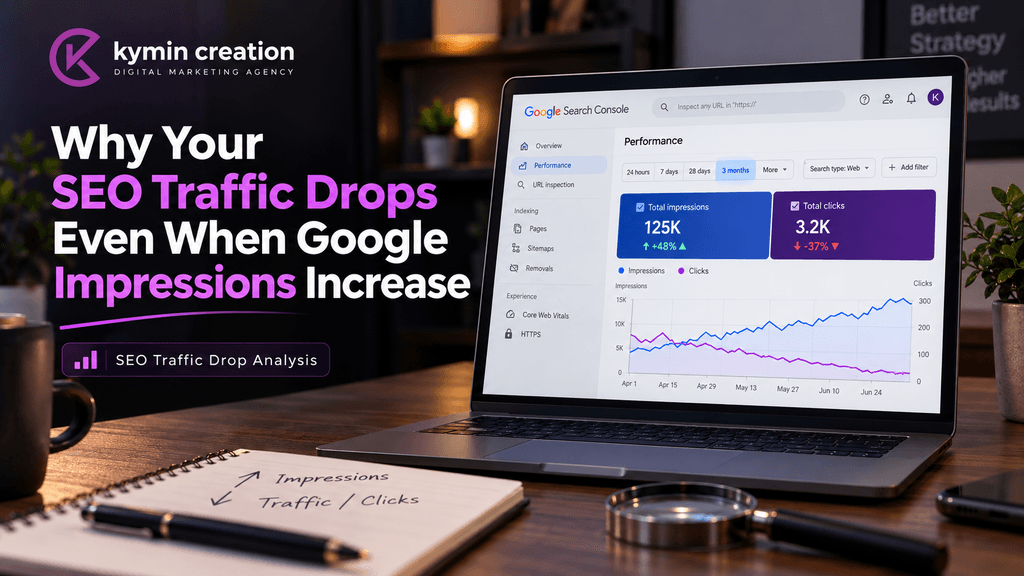
In Google Search Console:
- Impressions show how often your website appeared in Google Search.
- Clicks show how many users actually visited your website.
- CTR measures the percentage of impressions that generated clicks.
- Average position indicates roughly where your pages appeared in search results.
For example, imagine your website had 20,000 impressions, 500 clicks and a 2.5% CTR. Later it reaches 40,000 impressions, 450 clicks and a 1.1% CTR. Google is showing the website twice as often, but users are clicking it less frequently.
That usually means your visibility has expanded into lower positions, less relevant queries or more competitive SERPs.
1. Your Rankings May Have Dropped While Impressions Increased
One of the most common reasons is ranking dilution. A website may begin appearing for more keywords while simultaneously losing strong positions for its most valuable terms.
For example, a page previously ranking at position 4 may move to position 11 while Google starts showing it for dozens of additional long-tail keywords. Total impressions increase, but clicks from the main commercial keyword can fall sharply.
What to Check
Open Google Search Console and compare:
- Previous 28 days vs latest 28 days
- Clicks
- Impressions
- CTR
- Average position
Then inspect your most important queries individually. A site-wide average can hide major ranking losses on high-value keywords.
2. Your Organic CTR Is Falling
CTR is one of the first metrics to investigate when impressions rise without corresponding traffic growth. If impressions increase by 30% but clicks remain flat, your CTR will naturally decline.
Common reasons include:
- Your title is less attractive than competitors.
- Your meta description does not answer the user’s question.
- Your page appears below ads, maps or AI-generated results.
- Search intent has changed.
- Google rewrites your title.
- Competitors use stronger messaging.
- Your ranking moved from the top five into lower positions.
How to Improve CTR
Review pages with high impressions but low CTR and improve page title clarity, search-intent alignment, benefit-driven wording, specificity, freshness signals where genuinely relevant, meta descriptions and page-topic consistency.
Do not simply add words like “Best”, “No.1” or “Top” everywhere. The title should accurately communicate why the user should choose that result.
3. Keyword Cannibalization Can Cause an SEO Traffic Drop
Keyword cannibalization occurs when multiple pages on your website target the same or highly similar search intent.
For example, a digital marketing website might publish several pages around variations such as “Best SEO Company in Ahmedabad”, “Top SEO Company in Ahmedabad”, “Best SEO Agency in Ahmedabad” and “Which Is the Best SEO Company in Ahmedabad?”. These pages may look different to the website owner, but Google may consider them extremely similar.
Instead of strengthening one authoritative page, ranking signals become distributed across several URLs. This can create ranking fluctuations, the wrong URL ranking, lower CTR, unstable positions and difficulty moving into top positions.
How to Fix Cannibalization
Start by mapping one primary URL to each important search intent. Then decide whether overlapping pages should be rewritten for a different intent, consolidated, used as supporting informational content, internally linked to the primary page or redirected only when consolidation is genuinely appropriate.
Before consolidating pages, it also helps to understand how to evaluate an SEO agency and the process it should use for auditing overlapping content.
Do not mass-delete pages just because they target similar keywords. First check traffic, backlinks, conversions and long-tail keyword visibility.
4. Google May Be Showing You for Less Relevant Queries
More impressions are not always better. Google can begin testing your content against broader queries.
Suppose your page is about an SEO agency in Ahmedabad. Over time, Google may show it for searches such as SEO meaning, SEO course, SEO salary, free SEO tools, how to learn SEO or SEO jobs Ahmedabad. Those impressions increase visibility numbers but may have little commercial value for an agency.
The result is simple: more impressions + lower CTR + little or no business growth.
What to Do
In Search Console, inspect the Queries report and ask whether new impressions are coming from relevant searches, whether they are commercially useful, whether the page actually answers those queries and whether a separate informational article should target them.
SEO performance should be evaluated through relevant visibility, not just total impressions.
5. Search Intent May Have Changed
Google’s interpretation of a keyword can change. A search query that previously returned agency service pages may gradually begin showing comparison articles, listicles, videos, Google Business Profiles, Reddit discussions, AI-generated answers or educational pages.
If your page format no longer matches the dominant intent, impressions can remain high while clicks and rankings decline.
For example, “social media marketing agency in Ahmedabad” is generally commercial, while “how social media marketing helps small businesses” is informational. Using the same sales-focused page structure for both queries may limit performance.
6. Your Page Titles May Be Too Similar
Many websites create dozens of titles such as “Best SEO Company in Ahmedabad”, “Top SEO Company in Ahmedabad”, “No.1 SEO Company in Ahmedabad” and “Leading SEO Company in Ahmedabad”. From an SEO perspective, this creates weak differentiation.
Better titles should describe a specific problem or purpose, such as:
- SEO Pricing in Ahmedabad: What Should Businesses Expect?
- SEO Retainer vs Project SEO: Which Model Fits?
- How to Evaluate an SEO Agency Before Signing
- SEO ROI: How to Measure Agency Performance
If you are deciding between an ongoing engagement and a one-time project, this SEO retainer vs project SEO guide explains the difference in scope and continuity.
7. Competitors May Have Improved Their Search Results
Sometimes your website has not become significantly worse. Your competitors have simply become better.
They may have improved content depth, page experience, backlinks, brand authority, internal linking, local SEO, case studies, titles and descriptions, website speed or topical coverage.
If three competitors move above you, your impressions may still remain strong because Google continues displaying your page. But your CTR can decrease dramatically. This is why ranking position should always be analyzed together with impressions and clicks.
8. AI Overviews and SERP Features Can Reduce Clicks
Modern Google search results contain much more than traditional blue links. Users may now encounter AI-generated summaries, featured snippets, People Also Ask, local map packs, videos, shopping results, forums and images.
A user may get enough information directly from the search results without clicking a website. This means increasing impressions do not automatically guarantee increasing traffic.
For informational content, websites should therefore focus on providing something the SERP cannot fully replace, such as original research, real case studies, first-party experience, detailed examples, calculators, templates, screenshots, proprietary data and expert interpretation.
9. Weak Internal Linking Can Dilute Page Authority
Internal linking tells Google which pages are important and how different topics relate to one another. If dozens of blog posts mention SEO but none consistently link to your primary SEO page, Google receives weaker structural signals.
A better architecture uses a main service page supported by focused articles on SEO pricing, SEO ROI, local SEO, agency hiring, technical SEO and case studies. Each supporting article should naturally point users toward the main commercial page when relevant.
For local visibility specifically, use a practical local SEO checklist for Ahmedabad businesses to strengthen Google Business Profile, local pages, citations and internal links.
At Kymin Creation, this type of topic-to-service mapping is especially important because an agency website often contains many closely related service and blog topics.
10. Publishing More Content Is Not Always the Solution
When traffic starts falling, many websites react by publishing even more articles. That can make the problem worse.
If existing pages already overlap, creating another near-identical article adds more cannibalization, crawl complexity, thin content, internal competition and maintenance work.
Instead, audit what already exists. Sometimes improving five existing pages produces more value than publishing 30 new ones.
How to Diagnose an SEO Traffic Drop Step by Step
Step 1: Compare Time Periods
Compare the last 28 days, previous 28 days and the same period last year where useful. Look for changes in clicks, impressions, CTR and rankings.
Step 2: Check Individual Pages
Find pages with rising impressions, falling clicks and falling CTR. These should become your first audit candidates.
Step 3: Analyze Queries
Separate commercial keywords, informational keywords, branded searches, non-branded searches, relevant queries and irrelevant queries.
Step 4: Check Ranking Position
Determine whether valuable terms have moved from positions 1–3 to 5–10, from positions 5–10 to page two, or from page two into deeper results. Even small ranking drops can significantly reduce clicks.
Step 5: Audit Search Intent
Search the keyword manually and inspect what Google currently ranks. Compare content type, page format, SERP features, competitors and search intent.
Step 6: Check Cannibalization
Identify multiple URLs receiving impressions for the same core query. Decide which page should own that intent.
Step 7: Improve Existing Pages
Prioritize content usefulness, titles, meta descriptions, internal links, unique expertise, case studies and query alignment. A broader SEO checklist can help you review the fundamentals systematically.
Step 8: Measure Again
SEO changes should be evaluated over time. Track qualified clicks, conversion rate, leads, non-brand visibility, target-page rankings and CTR.
Rankings alone are not enough; businesses should also understand how to measure SEO ROI using leads, conversions and qualified organic traffic.
Should You Worry If Impressions Increase but Clicks Drop?
Not immediately. Sometimes impressions rise because Google is testing your website for more keywords. That can eventually create additional opportunities.
The problem begins when high-value keywords lose rankings, CTR consistently declines, qualified clicks decrease, leads decline or multiple pages compete for the same query. That is when an SEO audit becomes necessary.
Kymin Creation recommends looking beyond surface-level numbers and identifying which pages, queries and search intents are actually responsible for the change.
Final Thoughts
Higher Google impressions are not automatically a sign of stronger SEO. Your website can receive more visibility while losing the clicks that matter most.
An SEO Traffic Drop with increasing impressions commonly comes from ranking dilution, weaker CTR, keyword cannibalization, irrelevant query exposure or changing search intent.
The solution is not simply publishing more content. It is building a cleaner SEO structure where each important search intent has a clear primary page, supporting articles serve unique purposes, internal links reinforce the correct pages, titles match user expectations and performance is measured through qualified traffic and conversions.
If your business is deciding where SEO fits alongside paid acquisition, this PPC vs SEO guide for Ahmedabad businesses provides a useful comparison of speed, cost and long-term value.
For businesses that need help identifying why rankings or organic traffic are declining, Kymin Creation provides SEO strategy, technical analysis, content optimisation and performance-focused search marketing support.
FAQs
Why are my Google impressions increasing but clicks decreasing?
This usually happens when your pages appear for more searches but rank lower, attract less relevant queries or receive a lower CTR.
Does higher impression always mean better SEO?
No. Higher impressions only indicate greater search visibility. They do not guarantee better rankings, qualified traffic, leads or revenue.
Can keyword cannibalization reduce website traffic?
Yes. Multiple pages targeting the same search intent can divide ranking signals and cause unstable rankings or the wrong URL to appear.
How can I identify pages causing an SEO traffic decline?
Use Google Search Console to compare pages by clicks, impressions, CTR and average position across different time periods.
Should I delete pages that target similar keywords?
Not automatically. Review each page’s rankings, traffic, backlinks and intent first. Some should be differentiated, others consolidated, and only certain pages may require redirects.
How often should SEO performance be reviewed?
Core SEO metrics should generally be monitored monthly, while major changes should be evaluated over a longer period to avoid reacting to normal daily ranking fluctuations.
Can improving titles increase organic clicks?
Yes. A clearer and more relevant title can improve CTR when the page already has good search visibility, provided the title accurately reflects the page content.