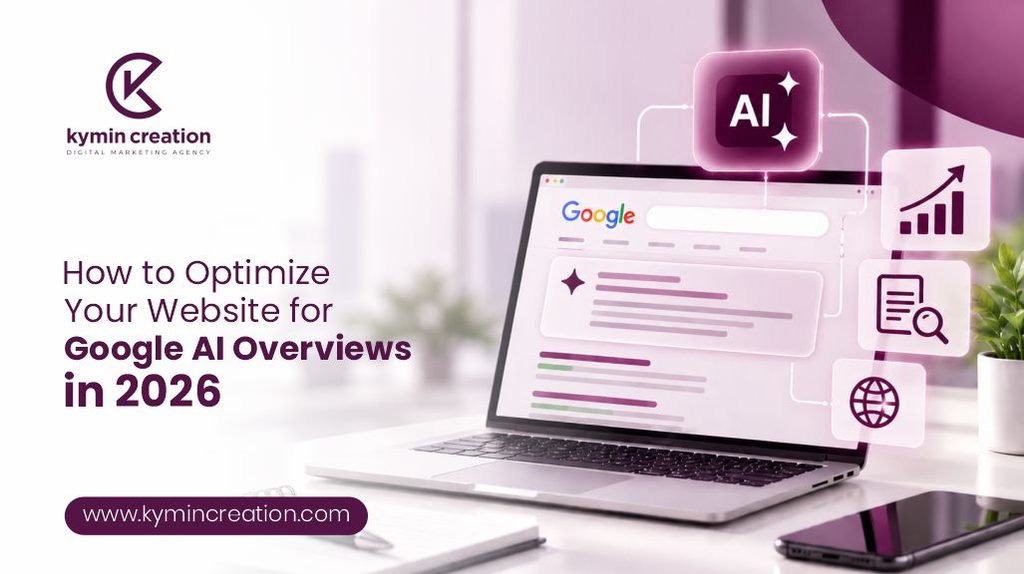
How to Optimize Your Website for Google AI Overviews in 2026
Google Search is evolving rapidly as artificial intelligence changes how people discover information, compare services and make purchasing decisions. With Google AI Overviews and AI Mode becoming important parts of the search experience, businesses need to understand how their websites can remain visible in this changing digital landscape.
For businesses in Ahmedabad and across India, this shift creates an opportunity to strengthen their online presence through high-quality content, technical SEO, local search optimization and a better user experience.
However, optimizing for AI-powered search does not mean abandoning traditional SEO. Google’s guidance continues to emphasize helpful, reliable, people-first content and established SEO fundamentals. There is no guaranteed method to make a website appear in AI Overviews, and no special AI markup is required.
In this guide, Kymin Creation, a digital marketing agency in Ahmedabad, explains how Google AI Overviews work, the latest Google Search developments in 2026, and the practical steps businesses can take to improve their search visibility.
What Are Google AI Overviews?
Google AI Overviews are AI-generated summaries that appear in Google Search for selected queries. They help users understand a topic by bringing together relevant information and providing links to websites where they can explore the subject further.
For example, someone searching for “best digital marketing agency in Ahmedabad” may encounter a mixture of traditional search results, business listings and AI-powered search features, depending on the query and Google’s systems.
AI Overviews can be useful for complex questions that benefit from explanations, comparisons or information drawn from multiple sources.
Key characteristics include:
- AI-generated summaries: Users can get an overview of a topic without opening several pages first.
- Links to supporting websites: Users can visit relevant pages to verify information or explore a subject in more detail.
- Query-dependent visibility: AI Overviews do not appear for every search query.
- Multiple information sources: Google’s systems may identify relevant pages covering different aspects of a question.
- Opportunities for discovery: Useful content can provide a route for users to discover businesses and websites.
AI Overviews are different from traditional blue-link results and from AI Mode, which supports more conversational exploration and follow-up questions within Google Search.
For businesses, the objective should be to publish genuinely useful information that deserves to be discovered, rather than simply trying to manipulate an AI-generated answer.
Latest Google AI Search Updates in 2026
Google has introduced several developments that website owners, SEO professionals and digital marketers should understand.
1. October 15, 2026: More Visible Links in AI Search
Google announced updates to AI Mode and AI Overviews on October 15, 2026, designed to help users explore websites more easily.
The announced changes include:
- More prominent inline links within AI-generated responses.
- Improvements that can make important source links appear higher in responses.
- Testing a dedicated section for official websites, with context explaining their usefulness.
- Updated visual experiences for discovering timely news and related content.
- Clickable creator profiles to help users understand the sources behind information.
These changes reinforce the importance of creating pages that provide useful, credible information and give visitors a reason to click through.
What this means for businesses: Do not focus only on appearing in a summary. Make sure your website provides the additional details, original insights, examples and services that users need after discovering your content.
2. August 31, 2026: Generative AI Search Controls and Performance Insights
Google announced new tools to help website owners understand and manage their presence in AI-powered Search features.
As of August 31, 2026, Google reported that its Search generative AI control and performance insights had rolled out worldwide.
The developments include:
- A control in Search Console for managing whether a site’s links and content can be included in supported generative AI Search features.
- Performance insights showing organic impressions from Search generative AI features.
- Information about pages receiving AI-feature impressions.
- Breakdown information that can include countries and devices.
These capabilities help website owners evaluate how their content appears across AI-powered search experiences.
What this means for businesses: Check Google Search Console to understand whether the new reporting is available for your website. Use the available data to identify pages receiving AI-search impressions and improve relevant content where needed.
3. May 15, 2026: Google Published a Guide to Generative AI Search Optimization
Google Search Central published a dedicated resource on optimizing websites for generative AI features in Search on May 15, 2026.
The guidance emphasizes several important principles:
- Create unique content that offers genuine value.
- Avoid publishing generic content that adds little beyond existing information.
- Continue following established SEO best practices.
- Provide relevant local, shopping, image and video information where appropriate.
- Understand the distinction between useful optimization and unsupported AEO or GEO claims.
The central message is that strong SEO fundamentals remain relevant as search evolves.
What this means for businesses: Instead of producing large volumes of similar AI-written articles, invest in content that demonstrates practical expertise, answers customer questions and provides information that readers cannot easily get from a generic summary.
4. October 1, 2026: Updated Guidance on Generative AI Content
Google Search Central’s documentation update log recorded an update to its guidance on using generative AI content on October 1, 2026.
This is an important reminder for businesses using AI tools to support their content production.
AI can help with research, outlining, editing and brainstorming. However, automatically generating large quantities of low-value pages to influence rankings can violate Google’s spam policies.
Businesses should focus on:
- Fact-checking AI-generated information.
- Adding original analysis and relevant experience.
- Correcting unsupported claims.
- Ensuring the final article answers the user’s actual question.
- Reviewing content for accuracy, originality and usefulness before publication.
AI should improve the content creation process, not replace editorial judgment.
Official references for these developments are provided at the end of this article.
How to Optimize Your Website for Google AI Overviews in 2026
There is no guaranteed shortcut to appearing in AI Overviews. Nevertheless, businesses can improve their eligibility and the usefulness of their pages by following established SEO principles.
1. Create Helpful, Original and People-First Content
Content quality remains one of the most important areas to prioritize.
A page that repeats information already available across dozens of websites may provide little reason for users or search systems to choose it.
To improve content quality:
- Answer the main question clearly near the beginning of the page.
- Provide practical examples, explanations and supporting details.
- Include original research, observations or case studies where possible.
- Keep statistics and factual claims accurate and verifiable.
- Explain complex concepts using straightforward language.
- Remove unnecessary repetition and keyword stuffing.
- Update information when circumstances or official guidance change.
For example, a generic article about SEO services may not be as useful as a detailed guide explaining how a local business can improve its Google Business Profile, measure qualified leads and fix common website issues.
At Kymin Creation, the aim should be to demonstrate practical digital marketing knowledge rather than merely publish articles for the sake of increasing website content.
2. Target Search Intent and Related Questions
Keyword research should identify what users want to accomplish, not simply the phrases they type into Google.
Search intent can be divided into several broad categories:
- Informational: Users want to learn something, such as how AI Overviews work.
- Commercial investigation: Users compare agencies, tools or services before making a decision.
- Transactional: Users are ready to purchase or enquire about a service.
- Navigational: Users want to find a particular brand or website.
A digital marketing agency should build content around all relevant stages of the customer journey.
For example, a business owner searching for “what is local SEO” may need an educational guide. Someone searching for “SEO company in Ahmedabad” may be closer to contacting an agency.
Build a content plan that connects these searches through relevant internal links.
3. Structure Pages with Clear Headings and Direct Answers
Clear content structure helps readers understand information and makes pages easier to navigate.
Use descriptive headings and organize the article logically.
Recommended practices include:
- Use one clear H1 that describes the page’s main topic.
- Organize major sections with relevant H2 headings.
- Use H3 headings for supporting topics.
- Place the direct answer near the start of a section.
- Use bullet points for lists, steps and important considerations.
- Include tables when they make comparisons easier.
- Keep paragraphs focused on one main idea.
For instance, a page about local SEO should explain what local SEO is, why it matters, how Google Business Profile optimization works and how businesses can measure results.
Important: Clear formatting improves usability, but it does not guarantee that Google will select a page for an AI Overview.
4. Strengthen Technical SEO and Indexability
Before focusing on AI search visibility, confirm that Google can access and index the relevant pages.
Technical problems can prevent otherwise useful content from appearing in search results.
Review the following:
- Check important URLs using Google Search Console’s URL Inspection tool.
- Ensure relevant pages are not accidentally blocked by robots.txt.
- Review noindex directives and canonical tags.
- Maintain an accurate XML sitemap.
- Fix important broken internal links.
- Use logical website navigation.
- Make important page content available as readable text.
- Check mobile usability and page experience.
- Monitor server errors and crawling problems.
Structured data should be implemented correctly when it applies to the page. The markup must match the visible content and should not be used to claim unsupported information.
Google’s current guidance does not require special AI-specific structured data to appear in AI Overviews or AI Mode.
5. Build Relevant Internal Links
Internal linking helps users discover related information and helps search engines understand how pages relate to one another.
For example, a website offering SEO services could connect:
- A guide to Google AI Overviews.
- A technical SEO checklist.
- A local SEO guide for Ahmedabad businesses.
- A page explaining SEO audit services.
- A page describing the agency’s SEO services.
Use descriptive anchor text that accurately explains the destination page.
Avoid inserting irrelevant links simply to increase the number of internal links. Each link should help the reader continue their research or take a useful next step.
6. Demonstrate Experience, Expertise and Trustworthiness
Businesses should make it easy for readers to understand who created their content and why the information deserves consideration.
Useful practices include:
- Add clear author information where appropriate.
- Explain relevant professional experience.
- Cite reliable sources for factual claims.
- Publish original case studies when permission and evidence are available.
- Keep business contact information accurate.
- Maintain a clear About page.
- Correct errors promptly.
- Distinguish verified results from estimates or opinions.
For a digital marketing agency, a properly documented case study showing the starting position, work completed, measurement period and observed results can be more useful than unsupported claims about guaranteed rankings.
Trust should be built through transparency and evidence, not exaggerated marketing language.
7. Optimize Local SEO for Ahmedabad Searches
Local search is particularly relevant to businesses that serve customers in a specific geographic area.
For Kymin Creation, local SEO can support visibility among businesses searching for digital marketing services in Ahmedabad.
Focus on:
- Maintaining an accurate Google Business Profile.
- Choosing appropriate business categories.
- Keeping business hours, contact details and service information updated.
- Publishing useful location-relevant website content.
- Building legitimate local citations.
- Earning genuine customer reviews without incentives or manipulation.
- Creating service pages that address the needs of local businesses.
- Tracking relevant enquiries and conversions.
A useful local page should provide more than the city name repeated throughout the content. Include relevant service information, local customer needs, examples and clear ways to contact the business.
Local SEO does not guarantee inclusion in an AI Overview, but it can strengthen the overall quality and discoverability of a local business’s online presence.
8. Use High-Quality Images and Video
Google’s generative AI guidance also discusses providing relevant image and video content where it benefits users.
Visual content can make a page easier to understand and may help businesses communicate complex ideas.
Consider adding:
- Original screenshots that explain a process.
- Relevant photographs of products, services or projects.
- Short explanatory videos.
- Charts based on verified data.
- Descriptive image alt text where appropriate.
- Useful captions and contextual explanations.
Compress images appropriately and avoid using decorative visuals that add no meaningful value.
Do not create an image simply to fill space. Each visual should support the page’s purpose.
9. Measure Performance with Google Search Console and Analytics
SEO decisions should be based on evidence rather than assumptions about what AI systems might prefer.
Google Search Console can help you monitor search impressions, clicks, click-through rates, queries and page performance. Its generative AI performance insights can provide additional information about visibility in supported AI Search features when sufficient data is available.
Use the data to investigate:
- Which pages are gaining or losing impressions.
- Which search queries attract relevant visitors.
- Whether important pages are indexed.
- Which pages attract qualified enquiries.
- Whether changes to content improve performance over time.
Google Analytics can complement Search Console by helping you evaluate engagement, leads and other business outcomes.
Remember that impressions do not automatically translate into clicks, and clicks do not necessarily translate into customers. Measure the outcomes that matter to your business.
Common Myths About Google AI Overviews and SEO
As AI-powered search becomes more prominent, several misconceptions can lead businesses to waste time or money.
Myth 1: Traditional SEO Is No Longer Important
Reality: Google’s guidance explicitly states that existing SEO fundamentals remain relevant to AI Overviews and AI Mode.
Technical accessibility, helpful content, internal linking and compliance with Search policies still matter.
Myth 2: Every Website Needs an llms.txt File to Rank in AI Search
Reality: Google clarified in its June 2026 documentation updates that llms.txt is not required for Google Search and does not improve or harm visibility in Google Search simply by being present.
Do not prioritize creating such a file as a replacement for essential SEO work.
Myth 3: Adding FAQ Schema Guarantees AI Overview Visibility
Reality: There is no special FAQ or AI schema that guarantees inclusion in AI Overviews. Google also deprecated its FAQ rich-result feature in May 2026.
FAQs can still help readers when they answer genuine questions, but their presence should not be treated as a ranking shortcut.
Myth 4: Publishing More AI Content Automatically Improves Rankings
Reality: Using AI is not inherently a problem, but producing large volumes of unoriginal or low-value pages to manipulate search rankings can violate Google’s spam policies.
Quality, originality, relevance and accuracy matter more than publishing volume alone.
Myth 5: Ranking in an AI Overview Can Be Guaranteed
Reality: Google determines when AI features appear and which supporting links are shown. No agency can honestly guarantee that a particular page will be cited in every AI-generated response.
A reliable SEO strategy focuses on improving the website’s overall quality and measuring actual results.
A Practical 30-Day Action Plan for AI Search Optimization
Businesses do not need to rebuild their entire website to begin improving their search readiness. A structured plan can help prioritize the most important work.
Week 1: Technical and Content Audit
- Review important pages in Google Search Console.
- Identify indexing, canonical and crawling issues.
- Check website navigation and internal links.
- Identify outdated, thin or repetitive content.
- Review the site’s mobile experience.
Week 2: Content Improvements
- Update priority service pages.
- Improve introductions and direct answers.
- Add original examples and supporting evidence.
- Review headings and related keyword coverage.
- Add relevant internal links.
Week 3: Local and Brand Optimization
- Update Google Business Profile information.
- Review local service pages.
- Improve business contact and About information.
- Verify business details across relevant directories.
- Review existing reviews and customer feedback.
Week 4: Measurement and Next Steps
- Establish baseline Search Console performance.
- Review available generative AI search insights.
- Track organic enquiries and relevant conversions.
- Identify pages requiring further improvements.
- Create a content plan based on actual customer questions.
This is an implementation framework, not a promise of rankings within 30 days. SEO performance depends on competition, website condition, content quality and many other factors.
How Kymin Creation Can Help Your Business Adapt to AI Search
Kymin Creation helps businesses strengthen their digital presence through SEO, technical website optimization, local SEO, content marketing, social media marketing and WordPress website services.
As search experiences evolve, businesses need a strategy that combines established SEO principles with useful content and effective measurement.
Our digital marketing services can support businesses through:
- SEO audit and optimization: Identify technical issues, content gaps and opportunities to improve organic visibility.
- Local SEO: Improve the quality and consistency of your local search presence.
- Content marketing: Develop relevant articles and service pages around customer needs.
- Website optimization: Improve website structure, usability and mobile experience.
- Google Business Profile optimization: Keep business information accurate and support local discovery.
- Analytics and reporting: Track search performance, traffic and business outcomes.
For companies in Ahmedabad, a well-planned digital marketing strategy can help establish stronger online visibility and create more opportunities to connect with relevant customers.
The right approach depends on your website, industry, competition and business objectives. Start with an assessment of the current situation, prioritize the most important improvements and measure progress consistently.
Want to improve your website’s search visibility? Contact Kymin Creation to discuss your SEO goals and identify practical opportunities to strengthen your online presence.
Frequently Asked Questions
1. What are Google AI Overviews?
Google AI Overviews are AI-generated summaries that appear for selected searches. They provide an overview of a topic and links to relevant websites where users can explore information further.
2. How can I get my website featured in Google AI Overviews?
There is no guaranteed method. Ensure your pages are accessible and eligible for Google Search, publish useful and original content, follow Search policies, strengthen internal links and maintain a good user experience.
3. Are AI Overviews and AI Mode the same?
No. AI Overviews provide summaries within search results for selected queries. AI Mode offers a more conversational search experience that supports follow-up questions and deeper exploration.
4. Does Google require special schema for AI Overviews?
No. Google states that no special AI-specific structured data is required to appear in AI Overviews or AI Mode. Use structured data when appropriate and ensure it accurately reflects visible page content.
5. Does llms.txt help websites rank in Google AI Overviews?
Google’s published guidance says llms.txt is not required for Google Search and does not improve or harm Google Search visibility simply by being present. Prioritize established SEO practices instead.
6. Can AI-generated blog posts rank on Google?
AI-assisted content can be useful when it is accurate, original, relevant and created to help users. Automatically generating large quantities of unhelpful content to manipulate rankings can violate Google’s spam policies.
7. How can I track AI Search performance?
Use Google Search Console to review search performance and, where available, the generative AI performance report. Google Analytics can help evaluate traffic quality, engagement and conversions.
8. How long does it take to improve AI search visibility?
There is no fixed timeline. Improvements depend on the website’s technical condition, content quality, competition, crawling and indexing, and how Google’s systems select sources for each query.
Conclusion
Google AI Overviews are changing how people discover and explore information, but they do not eliminate the need for strong SEO.
Google’s 2026 updates point towards more visible source links, improved website-owner insights and continued emphasis on useful, original content. Businesses should respond by strengthening technical SEO, answering customer questions clearly, demonstrating expertise and measuring meaningful results.
For Kymin Creation, the opportunity is to help businesses build a stronger foundation for both traditional search and AI-powered discovery. Rather than chasing shortcuts or guaranteed AI placements, focus on making your website genuinely useful, trustworthy and easy to navigate.
A sustainable search strategy starts with the user, supported by sound SEO practices and consistent measurement.