🇮🇳 Independence Day 2026: 150 Years of Vande Mataram, The Story of India’s Tricolour & A New Digital India
Every year, 15 August reminds India of the day it became independent in 1947. But Independence Day is more than a date on the calendar. It is a moment to remember the journey that shaped modern India—and to think about the country we are building today.
In 2026, Independence Day comes at an interesting moment. India is celebrating its 80th Independence Day, while the country is also commemorating 150 years of Vande Mataram, one of the most recognised symbols of India’s freedom movement and national consciousness. The nationwide Vande Mataram commemoration runs from 7 November 2025 to 7 November 2026.
At the same time, India’s identity is increasingly connected with technology, startups, digital businesses, artificial intelligence and innovation.
So this Independence Day, instead of only asking “How did India become independent?”, we can also ask:
“How is India shaping its next chapter?”
🇮🇳 Why Is Independence Day Celebrated on 15 August?
India became independent from British rule on 15 August 1947.
The day marked the beginning of a new chapter for the country after a long freedom movement.
Today, Independence Day is observed across India with flag hoisting ceremonies, cultural programmes, patriotic performances and speeches.
The National Portal of India describes Independence Day as a reminder of the beginning of a new era after more than two centuries of British colonial rule.
But behind the celebrations are symbols that have their own fascinating stories.
One of them is Vande Mataram.
Another is the Indian Tricolour.
🎵 150 Years of Vande Mataram: Why Is It Trending in 2026?
One of the biggest historical themes connected with India’s national celebrations in 2026 is 150 years of Vande Mataram.
Written by Bankimchandra Chattopadhyay in 1875, Vande Mataram became an important part of India’s freedom movement and later came to hold a special place in the country’s national consciousness.
The Government of India began a year-long nationwide commemoration of its 150th anniversary on 7 November 2025, continuing until 7 November 2026.
That makes Vande Mataram 150 years a particularly relevant topic for Independence Day content in 2026.
The commemoration has included cultural programmes, mass singing, exhibitions and creative initiatives. In 2026, the Ministry of Culture also launched filmmaking initiatives inviting creators to explore the song through reels, AI films and short films.
This is particularly interesting in today’s digital age.
A song written 150 years ago is now being interpreted through:
Music → Films → Reels → AI → Digital Storytelling
That’s a powerful example of how history can continue to evolve with technology.
🎶 From Freedom Movement to Digital Storytelling
Vande Mataram wasn’t simply a piece of literature.
Over time, it became associated with India’s freedom movement and national identity. The Ministry of Culture notes that it was used as a rallying cry during the freedom struggle and continues to represent cultural memory and collective consciousness.
What’s interesting today is how the same historical story can reach a completely different audience.
A person in 1905 might experience it through a public gathering.
A person in 1950 might hear it through radio or a cultural programme.
A person in 2026 might discover its history through:
- Instagram Reels
- YouTube Shorts
- Podcasts
- Blogs
- AI-generated visual storytelling
- Digital exhibitions
The medium changes. The story continues.
🇮🇳 Who Designed the Indian National Flag?
Here’s another Independence Day question that many people search for:
Who designed the Indian National Flag?
The name most commonly associated with the design of India’s national flag is Pingali Venkayya, an Indian freedom fighter and designer who worked on different versions of the flag during the freedom movement.
However, the Tricolour we know today went through an evolution before being formally adopted.
The Constituent Assembly adopted the present form of India’s National Flag on 22 July 1947, just weeks before independence.
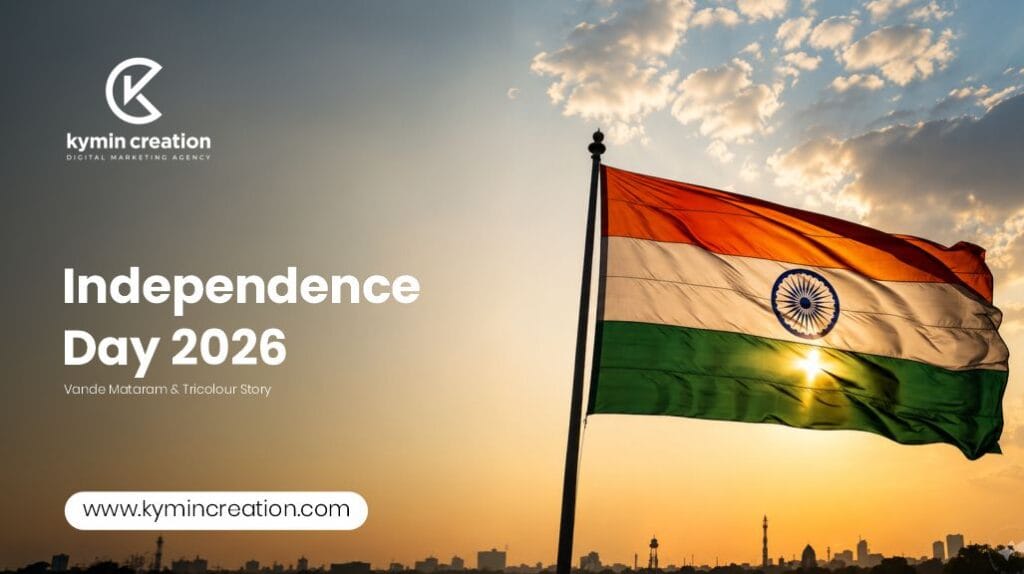
The flag consists of three horizontal bands:
Saffron → White → Green
At the centre is the navy-blue Ashoka Chakra with 24 spokes.
So, when someone asks, “Who made the Indian flag?”, the answer is more nuanced than simply naming one person.
Pingali Venkayya is closely associated with the development of the Indian flag design, while the present national flag was formally adopted by the Constituent Assembly in 1947.
🟠 What Does Saffron Represent?
The top band of the Indian flag is deep saffron.
It represents strength and courage.
The colour also carries a broader association with sacrifice and selflessness in India’s national symbolism.
⚪ What Does White Represent?
The middle band is white.
It represents peace and truth, with the Ashoka Chakra placed at its centre.
The white band also provides the background against which the navy-blue Chakra becomes clearly visible.
🟢 What Does Green Represent?
The bottom band is green.
According to the National Portal of India, green represents fertility, growth and auspiciousness of the land.
Together, the three colours create one of the most recognisable national symbols in the world.
☸️ Why Does the Indian Flag Have 24 Spokes?
The wheel in the centre of the flag is the Ashoka Chakra.
It is based on the wheel appearing on the abacus of the Lion Capital of Ashoka at Sarnath.
The Chakra contains 24 spokes.
The wheel is also associated with movement and progress.
And that idea feels particularly relevant to modern India.
A nation cannot grow by standing still.
🇮🇳 India’s Journey: From Tricolour to Technology
The India of 1947 and the India of 2026 are dramatically different.
The country has moved through multiple stages of transformation:
Independence → Nation Building → Industrialisation → Liberalisation → Digital Revolution → AI & Innovation
Today, technology is becoming part of almost every aspect of Indian life.
From digital payments to e-commerce.
From online education to cloud computing.
From startups to AI-powered businesses.
India’s digital ecosystem has created opportunities that previous generations could hardly have imagined.
💻 What Does Independence Mean for Businesses in 2026?
For today’s businesses, independence can also mean having the freedom to create, compete and reach customers digitally.
A small business can build a website.
A startup can reach customers across India through social media.
A creator can build a global audience.
A local business can use SEO to appear when customers search for its services.
An entrepreneur can use AI to improve productivity and marketing.
Digital technology has reduced many of the traditional barriers to entering a market.
That’s why digital independence is becoming an interesting concept for modern businesses.
🚀 The New Indian Business Is Digital
The modern Indian business landscape isn’t limited to traditional companies.
It includes:
- Startups
- D2C brands
- SaaS companies
- Creators
- E-commerce businesses
- Digital agencies
- AI startups
- Fintech companies
- Local businesses going online
For these businesses, digital presence isn’t just an option.
It can become a major part of their growth strategy.
A strong website, SEO strategy, social media presence and digital advertising can help a business reach customers beyond its physical location.
🤖 AI and the Future of Indian Businesses
Another major change happening in 2026 is the growth of Artificial Intelligence.
AI is increasingly being used for:
- Content creation
- Marketing automation
- Customer support
- Data analysis
- SEO research
- Personalisation
- Image and video production
- Business intelligence
But technology alone doesn’t create a successful brand.
Strategy still matters.
AI can help produce content faster.
But businesses still need to understand:
Who is the audience?
What problem are they solving?
Why should people trust them?
What makes their brand different?
The future isn’t necessarily AI versus humans.
It is more likely to be:
AI + Human Creativity + Strategy
📱 Independence Day Marketing in the Digital Era
Independence Day has also become an important moment for brands to communicate with their audiences.
But simply putting a Tricolour background behind a logo may not be enough anymore.
Brands can create more meaningful campaigns around ideas such as:
Freedom From Outdated Marketing
Talk about moving away from strategies that no longer work.
Freedom to Create
Highlight creativity, innovation and entrepreneurship.
Built in India
Showcase Indian products, people, technology or stories.
India’s Digital Journey
Connect the country’s technological growth with the brand’s own journey.
Stories Behind India’s Symbols
Create educational content around the flag, Vande Mataram, Ashoka Chakra and other national symbols.
The key is simple:
Don’t use Independence Day only as a greeting. Use it as a story.
🇮🇳 What Can Businesses Learn From India’s Journey?
India’s journey offers an important lesson for businesses:
Adaptation matters.
India has continuously evolved with changing circumstances.
Businesses need to do the same.
Marketing trends change.
Search behaviour changes.
Social media platforms change.
Technology changes.
Customer expectations change.
A strategy that worked five years ago may not work the same way today.
The brands that continue learning, experimenting and adapting are better positioned for long-term growth.

🌐 From Independent India to a Digitally Connected India
Independence gave India the opportunity to shape its own future.
Technology has given Indian businesses another opportunity:
the ability to connect with the world.
A company based in Ahmedabad, Mumbai, Delhi, Bengaluru or a smaller Indian city can potentially reach customers far beyond its local market.
A creator can publish content globally.
A startup can attract international customers.
An Indian brand can build a global identity.
This is one of the most exciting aspects of India’s digital transformation.
🇮🇳 Independence Day 2026: More Than a Celebration
This Independence Day carries several meaningful stories together.
79 years of independent India.
150 years of Vande Mataram’s legacy.
A national flag whose present form was adopted in 1947.
A rapidly changing digital economy.
A new generation building businesses through technology.
These stories may belong to different periods, but they share one common idea:
India keeps moving forward.
From handwritten manuscripts to smartphones.
From physical newspapers to digital media.
From traditional businesses to AI-powered startups.
The tools have changed.
The ambition continues.
Final Thoughts
Independence Day is often remembered through flags, celebrations and patriotic songs.
But behind those symbols are stories of people, ideas, creativity and transformation.
Vande Mataram’s 150-year journey reminds us that an idea can survive across generations.
The Indian Tricolour reminds us of the values and identity associated with the nation.
And India’s digital transformation shows us how quickly the country can adapt to a changing world.
For businesses, creators and entrepreneurs, perhaps the biggest takeaway is simple:
Freedom gives us the opportunity. What we build with it is up to us.
This Independence Day, let’s celebrate not only where India came from—but also where India is going.
🇮🇳 Happy Independence Day 2026!
Kymin Creation
Creating. Connecting. Converting.