
Can Google Detect AI-Written Content? What Changed in October 2026
Can Google detect AI-written content? Google uses advanced systems to detect spam, low-quality pages, and manipulative content. However, Google has not publicly confirmed that it can reliably identify every article created using artificial intelligence. The important distinction is that Google does not automatically penalize AI-generated content. Instead, it focuses on helpful, reliable, and people-first information.
On October 1, 2026, Google updated its official guidelines on generative AI content, bringing renewed attention to how businesses use artificial intelligence for SEO.
But does this mean AI-written blogs will stop ranking? Let’s explore what actually changed.
What Changed in Google’s AI Content Guidelines in October 2026?
According to Google Search Central’s October 2026 documentation updates, the October 1 change incorporated information from the Search Quality Raters Guidelines into Google’s generative AI content guidance.
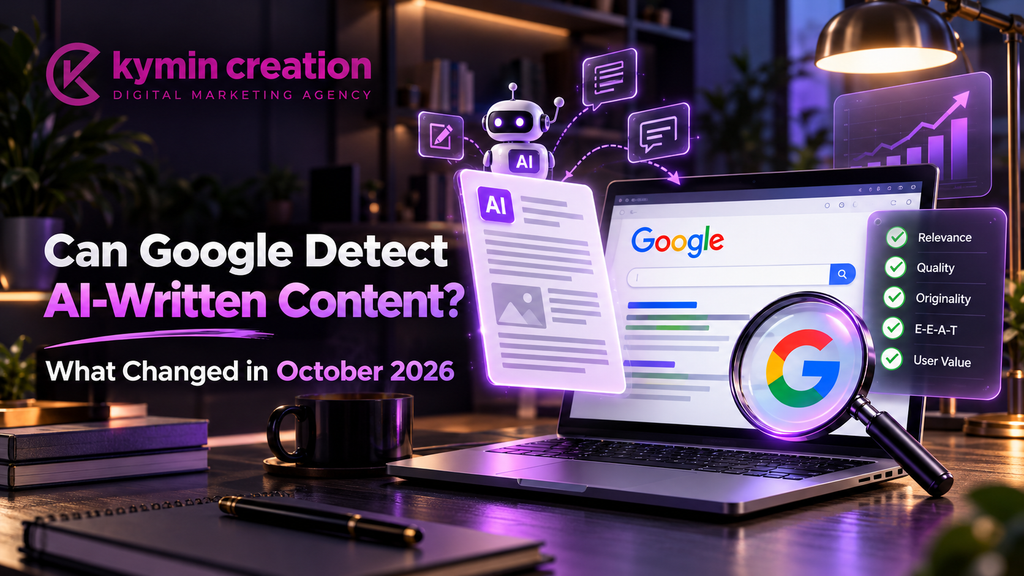
The update was intended to align its documentation with developer-event presentations. It did not announce a new algorithm specifically designed to penalize AI writing.
The key principles include:
- AI-generated content should deliver meaningful information to readers.
- Publishing large volumes of unoriginal pages to manipulate rankings may violate spam policies.
- Content should demonstrate accuracy, relevance, and usefulness.
- Businesses should review AI-generated information before publishing.
- Original research and firsthand expertise can improve content quality.
Google’s official guidance on using generative AI content explains the importance of adding value rather than simply generating large quantities of pages.
Can Google Actually Detect AI-Generated Articles?
Google uses automated systems, including SpamBrain, to identify spam and ranking manipulation.
However, identifying low-quality content is different from proving that an article was written using ChatGPT or another AI tool.
What Makes AI-Written Content Risky?
Several problems can reduce the usefulness of AI-generated articles:
- Repetitive information that offers nothing new.
- Keyword stuffing and unnatural sentence construction.
- Articles containing incorrect statistics or unsupported claims.
- Mass-produced blogs targeting nearly identical keywords.
- Content copied or lightly rewritten from competing websites.
- Articles created without understanding user search intent.
These issues can also affect human-written content.
For a deeper understanding of optimization mistakes, explore Kymin Creation’s article on why small business websites struggle to rank on Google.
Does Google Penalize AI-Written Content in 2026?
Google does not automatically penalize a page because AI assisted in its creation.
However, publishing content at scale primarily to manipulate rankings can violate Google’s policies.
The official Google Search spam policies describe scaled content abuse and other practices that website owners should avoid.
When AI Content Can Support SEO
AI-assisted writing can be useful when businesses:
- Research customer questions and relevant search queries.
- Create structured content outlines.
- Explain complicated subjects in accessible language.
- Incorporate verified examples and original insights.
- Review the content before publishing.
When AI Content Can Damage Website Performance
Potential problems arise when websites:
- Publish numerous nearly identical articles.
- Generate location pages without meaningful local information.
- Prioritize publishing volume over editorial quality.
- Produce misleading or factually incorrect content.
- Create pages only to capture keyword rankings.
Google evaluates many signals, so a traffic decline should never be attributed to AI content without investigating other possible causes.
For example, Kymin Creation’s guide on why SEO traffic drops despite higher impressions explains how changes in click-through rates, search features, and rankings can affect organic visits.
Why Original Content Matters More in 2026
Artificial intelligence has made content production easier for businesses of every size.
However, publishing a generic 1,000-word article is no longer enough to differentiate a website from competitors.
Consider two websites targeting the same search topic.
One publishes basic definitions and generic recommendations. The other provides relevant examples, actionable instructions, original observations, and answers to common customer questions.
The second offers readers a stronger reason to visit and engage with the website.
How Businesses Can Create More Useful Content
- Include real industry experiences and practical examples.
- Add original screenshots or research where possible.
- Explain how recommended strategies work.
- Address frequently asked customer questions.
- Update outdated information regularly.
- Connect related articles through relevant internal links.
Google’s guide to creating helpful, reliable, people-first content provides further information about evaluating content quality.
How to Use AI for SEO Without Compromising Quality
AI tools can improve productivity, but businesses still need a clear content strategy.
1. Understand User Search Intent
Before creating an article, identify what readers expect to learn.
Informational searches require useful explanations, while commercial searches often require comparisons, pricing considerations, or service details.
2. Add Relevant Human Expertise
AI-generated drafts should be reviewed and improved with industry knowledge.
Businesses can add:
- Customer questions.
- Authentic project examples.
- Industry-specific recommendations.
- Original research.
- Practical instructions.
3. Optimize Content Naturally
Avoid inserting keywords repeatedly simply to increase keyword density.
Instead, focus on descriptive headings, accurate information, appropriate internal links, and clear answers.
Businesses looking to strengthen their website structure can explore SEO services in Ahmedabad from Kymin Creation.
4. Improve Local SEO Relevance
Local businesses should ensure their content reflects the actual services and locations they serve.
Useful improvements include:
- Optimizing service and location pages.
- Maintaining accurate Google Business Profile details.
- Adding relevant local business information.
- Improving website navigation and internal linking.
- Creating content around genuine local search questions.
Explore Kymin Creation’s local SEO services for small businesses to understand how local visibility can be improved.
5. Monitor Organic Search Performance
After publishing content, use Google Search Console to evaluate website performance.
Review:
- Organic clicks and impressions.
- Search queries generating traffic.
- Average search positions.
- Indexing problems.
- Pages experiencing significant performance changes.
Use these findings to prioritize content improvements rather than assuming every ranking fluctuation is caused by AI.
What Does Google’s October 2026 Update Mean for Businesses in Ahmedabad?
For businesses in Ahmedabad, the update reinforces the importance of producing useful and relevant information.
Simply publishing AI-generated articles every day does not guarantee higher rankings.
A more sustainable approach combines search intent, useful content, technical optimization, and local SEO.
Whether a business operates in real estate, retail, hospitality, healthcare, or professional services, its website should answer genuine customer questions.
How Kymin Creation Helps Businesses Improve SEO Performance
At Kymin Creation, we focus on helping businesses improve their online visibility through structured, practical digital marketing strategies.
Our services include:
- SEO keyword research and content optimization.
- Technical SEO and website audits.
- Local SEO and Google Business Profile optimization.
- Content planning and internal linking.
- Website development and performance improvements.
- Search visibility and organic traffic analysis.
Rather than relying on publishing volume alone, Kymin Creation emphasizes relevant content and website improvements aligned with business objectives.
Businesses looking for professional support can contact Kymin Creation for an SEO consultation.
Frequently Asked Questions
Can Google detect ChatGPT-written content?
Google has sophisticated systems for detecting spam and manipulative content, but it has not publicly disclosed a guaranteed method for identifying every ChatGPT-written article.
Does Google penalize AI-generated blogs?
Not automatically. AI-generated content can appear in search results when it provides useful information and follows Google’s policies.
What changed in Google’s AI content guidelines in October 2026?
On October 1, 2026, Google updated its generative AI content guidance with information from its Search Quality Raters Guidelines. The change clarified existing quality principles rather than introducing a general ban on AI-written content.
Can AI content rank on Google in 2026?
Yes. AI-assisted content can rank when it satisfies relevant search intent and offers helpful, reliable information. Rankings also depend on other website and search factors.
How can businesses protect their SEO performance?
Businesses should focus on original insights, factual accuracy, relevant keyword targeting, internal linking, technical optimization, and ongoing content reviews.
Final Thoughts
Google’s October 2026 guidance highlights an important principle: content quality matters more than the writing tool used to produce it.
Rather than trying to hide AI involvement, businesses should focus on accuracy, originality, reader value, and a consistent SEO strategy.
AI can help create content faster, but useful information is what makes that content worth publishing.
For businesses seeking to improve organic visibility, Kymin Creation provides SEO and digital marketing services designed around relevant audiences and measurable business goals.